
Root Canal Treatment in Tujunga.
Root canal treatment in Tujunga, CA for infected, painful, or abscessed teeth. Doctor Dental provides diagnosis, infection-focused treatment planning, and restorative follow-up to help save natural teeth when possible.
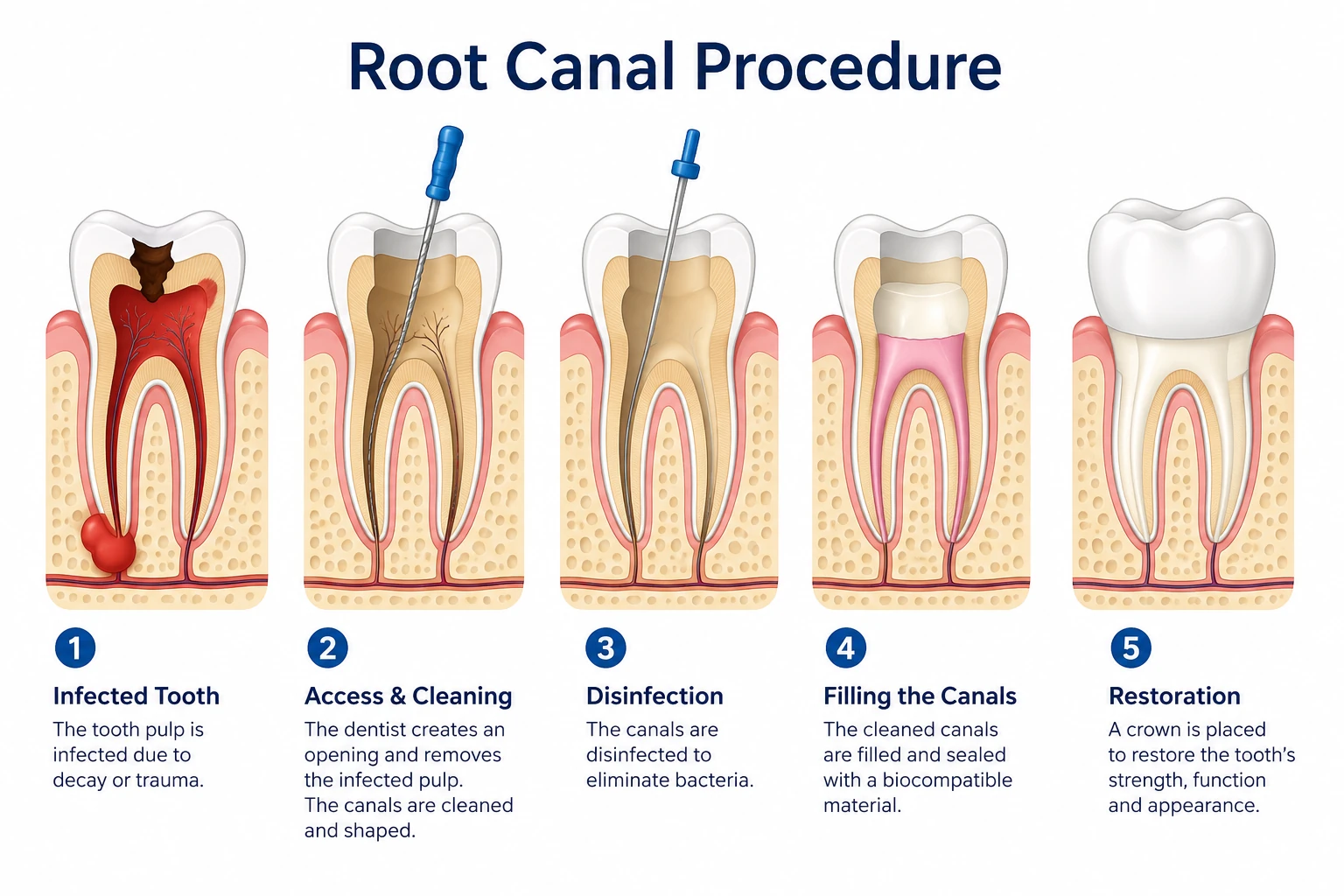
Is root canal treatment right for you?
Doctor Dental helps patients searching for root canal treatment in Tujunga, CA understand symptoms, options, insurance, financing, and the best next step.
Common reasons
- Deep tooth pain
- Sensitivity that lingers
- Swelling or infection near a tooth
Benefits
- Helps save the natural tooth
- Relieves infection-related pain
- Restores function with follow-up care
What to expect
The Doctor Dental team reviews your concerns, checks your teeth and gums, and explains recommended care before treatment begins.
Comfortable care, modern presentation.
Doctor Dental is designed to make dental visits easier to understand — with friendly communication, flexible payment options, and comprehensive services under one roof.
Call (818) 352-07076501 Foothill Blvd, Suite 101, Tujunga, CA 91042
All major PPO dental insurances and Denti-Cal.
Sunbit, Cherry, and CareCredit options may be available up to 24 months at 0%.
Root Canal Treatment: patient questions answered.
More detail for patients comparing root canal treatment in Tujunga, CA — including symptoms, options, cost factors, insurance, financing, and what to expect.
What it is
Root Canal Treatment is planned around your diagnosis, comfort, oral health, and long-term goals. Doctor Dental explains why treatment may be recommended and what alternatives may exist.
Who may need it
Patients with infected, inflamed, or severely painful teeth that may still be saved may benefit from an exam and a personalized recommendation.
What to expect
The visit focuses on diagnosis first. If root canal treatment is appropriate, the infected or inflamed tissue is removed, the canals are disinfected and sealed, and the tooth is restored.
Symptoms, options, and cost factors.
Dental treatment is not one-size-fits-all. Your final recommendation depends on exam findings, X-rays, gum health, bite, medical history, and your priorities.
Cost/insurance/financing: Cost depends on the tooth, X-rays, restoration needs, and insurance benefits. PPO insurance or Denti-Cal may help depending on coverage.
Important note: Delaying treatment can allow infection to spread or make the tooth harder to save.
- Lingering hot or cold sensitivity
- Spontaneous tooth pain
- Pain when biting
- Swelling or gum pimple near a tooth
- Deep cavity or cracked tooth reaching the nerve
- Root canal therapy to clean and seal the tooth
- Dental crown after root canal when the tooth needs protection
- Antibiotics only when clinically appropriate, not as a substitute for definitive treatment
- Extraction if the tooth cannot be predictably restored
Related dental services.
Explore related Doctor Dental services that may be part of your treatment plan.
Root Canal Treatment FAQs
1. What is a root canal?
A root canal is a dental treatment used to save a tooth when the soft tissue inside the tooth, called the pulp, becomes inflamed or infected.
During treatment, the infected or damaged tissue is removed from inside the tooth, the canals are cleaned and disinfected, and the space is sealed. The tooth is then restored so it can continue functioning normally.
2. How do I know if I need a root canal?
Common signs that a tooth may need root canal treatment include severe or lingering tooth pain, sensitivity to hot or cold, pain when biting, swelling of the gums, a pimple-like bump near the tooth, or darkening of the tooth.
Some infected teeth cause very little pain, so dental X-rays and an examination are often needed to determine whether the nerve inside the tooth has been damaged.
3. Is a root canal painful?
Modern root canal treatment is typically performed with local anesthesia, so patients should not feel pain during the procedure.
It is normal to experience some tenderness or soreness for a few days afterward, especially if the tooth was already infected or painful before treatment. Most post-treatment discomfort can be managed with the medications and instructions recommended by your dentist.
4. How long does a root canal take?
The length of a root canal appointment depends on the tooth being treated and the complexity of its root canals.
Many root canals can be completed in approximately 60 to 90 minutes, although some cases may require more than one appointment.
Molars typically have more canals than front teeth and may take longer to treat.
5. How much does a root canal cost?
The cost of root canal treatment varies depending on which tooth is being treated, the complexity of the root canal system, whether additional procedures are needed, and the patient’s dental insurance coverage.
Front teeth generally have fewer canals, while molars usually have several canals and can require more complex treatment.
A dental examination and X-rays are typically needed before an accurate treatment estimate can be provided.
6. Can antibiotics cure an infected tooth instead of a root canal?
Antibiotics may help control swelling or the spread of a dental infection, but they usually cannot eliminate an infection located inside the root canal system of a tooth.
If the pulp inside the tooth is infected or has died, the source of the infection generally needs to be treated with root canal therapy or the tooth may need to be extracted.
Antibiotics are sometimes prescribed in addition to dental treatment when there are signs that the infection has spread beyond the tooth.
7. What happens if I do not get a root canal when I need one?
An untreated infected tooth can continue to worsen. The infection may spread into the surrounding bone and tissues and can lead to increasing pain, swelling, an abscess, or loss of the tooth.
In some cases, the pain may temporarily decrease if the nerve dies, but the infection can still remain present.
Treating the tooth earlier may provide a better chance of saving it.
8. Should I get a root canal or have the tooth extracted?
When a tooth can be predictably restored, saving the natural tooth with root canal treatment is often preferred.
Removing a tooth can create additional problems, including shifting of nearby teeth, changes in the bite, and bone loss in the area. Replacing the missing tooth may later require a dental implant, bridge, or removable prosthesis.
However, extraction may be recommended when a tooth has a severe fracture, extensive decay, insufficient remaining tooth structure, or a poor long-term prognosis.
Your dentist can explain the advantages and disadvantages of each option based on the condition of the tooth.
9. Do I need a crown after a root canal?
Many teeth require a crown after root canal treatment, particularly molars and premolars.
Teeth that need root canal treatment often already have large fillings, decay, fractures, or significant loss of tooth structure. A crown can help protect the tooth from breaking under normal chewing forces.
Some front teeth may not require a crown if enough healthy tooth structure remains, but this depends on the individual case.
10. How long does a tooth last after a root canal?
A successfully treated and properly restored tooth can remain functional for many years and, in some cases, for the rest of a patient’s life.
Long-term success depends on factors such as the amount of healthy tooth structure remaining, the quality of the root canal treatment and final restoration, oral hygiene, bite forces, and regular dental care.
A crown or other final restoration should be completed when recommended to help protect the tooth.
11. Can a root canal fail?
Although root canal treatment has a high success rate, a treated tooth can sometimes develop another infection.
This can happen because of complex root anatomy, a missed canal, new decay, leakage around the restoration, a fracture, or contamination of the tooth.
Depending on the situation, the tooth may be treated again with root canal retreatment, evaluated for endodontic surgery, or removed if it cannot be predictably saved.
12. What should I expect after a root canal?
After a root canal, the tooth and surrounding tissues may feel tender for several days.
Patients should avoid chewing hard foods on the treated tooth until the permanent restoration has been completed, particularly if the tooth has a temporary filling.
You should contact your dentist if you develop significant swelling, severe pain that is getting worse, fever, or other unusual symptoms after treatment.
Root Canal Treatment in Tujunga, CA
Root canal treatment can often save a tooth that would otherwise need to be removed.
At Doctor Dental in Tujunga, we evaluate tooth pain, dental infections, cracked teeth, and other conditions that may require root canal treatment. Patients from Tujunga, Sunland, La Crescenta, La Cañada Flintridge, and surrounding communities can schedule an evaluation to determine the cause of their tooth pain and the appropriate treatment.
If you are experiencing persistent tooth pain, sensitivity, swelling, or pain when chewing, delaying treatment may allow the condition to become more serious.
Doctor Dental
6501 Foothill Blvd, Suite 101
Tujunga, CA 91042
(818) 352-0707
Explore more services.
Doctor Dental provides preventive, emergency, restorative, cosmetic, implant, and family dentistry.
Need root canal treatment?
Call Doctor Dental for appointments, questions, and emergency availability in Tujunga, CA.